The Bowl of Business Cards Is Where Leads Go to Die
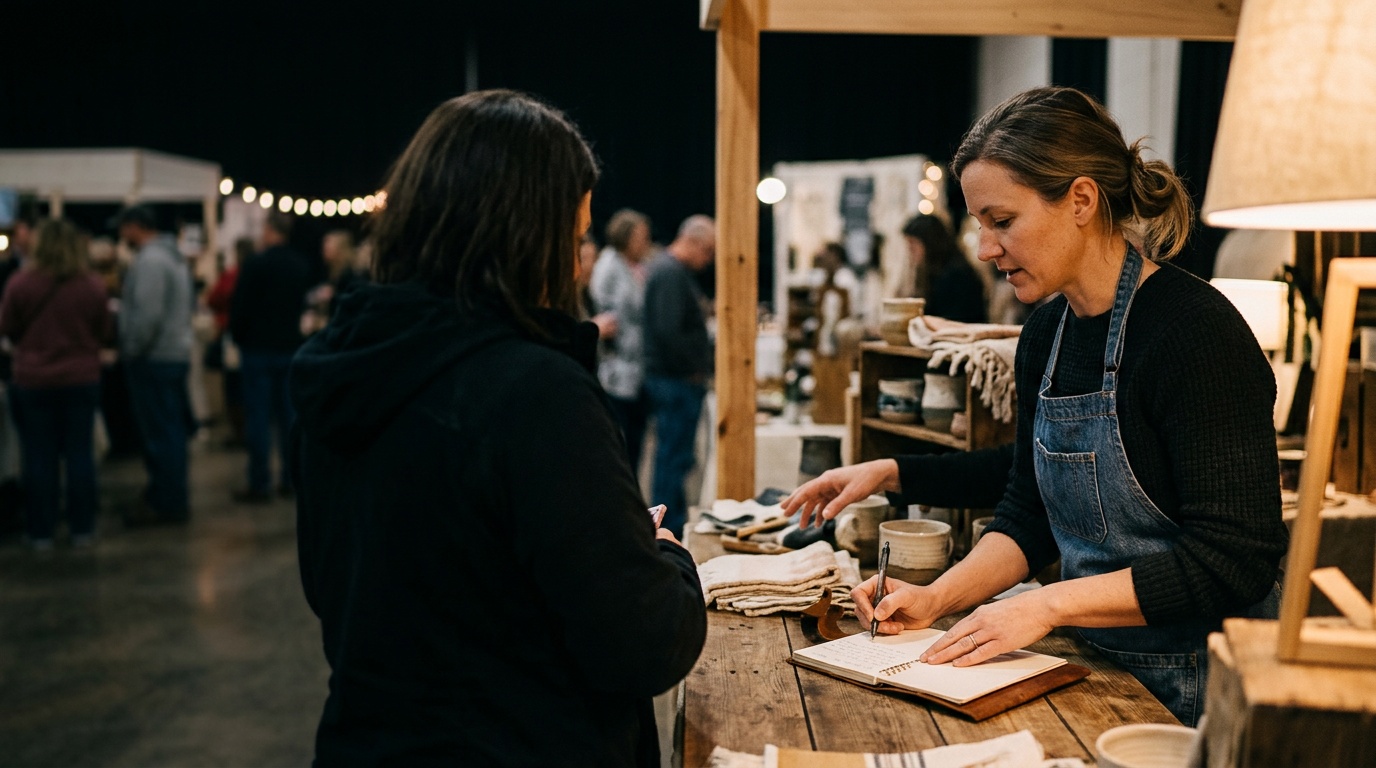
Every Kentucky small business owner has done this. You pay $150 for a booth at the county fair or the chamber's fall expo. You load up the truck with a folding table, a banner, a jar of candy, and a fishbowl. Three thousand people walk by. Two hundred stop. You collect eighty business cards and a sunburn.
Then Monday happens. The cards go in a drawer. Six weeks later you find them and have no idea which guy was the one who said he needed help with his website.
That's not a marketing problem. That's a systems problem. The booth worked fine. The event did its job. You just had nothing built to catch what fell out of it.
Here's the system that fixes it — booth setup, a single-question capture method, and the 72-hour follow-up sequence that turns conversations into actual revenue.
Why "Brand Awareness" Is the Most Expensive Lie at a Festival
When someone asks why you booked a booth at the World Chicken Festival or the chamber's business showcase and the answer is "exposure," you've already lost the money.
Awareness is a byproduct, not a goal. You cannot deposit awareness. And for a local business in a county of 40,000 people, awareness is cheap — people already drive past your sign.
What you're actually buying at a local event is something rarer: a few hundred face-to-face conversations with people who live within twenty miles of your business, compressed into eight hours. That is a lead generation opportunity disguised as a community event. Treat it like one.
The shift is simple. Stop measuring the day by how many people stopped. Start measuring it by how many named, tagged, followed-up-with contacts you have in a list on Monday morning.
Before You Load the Truck: Pick One Offer
The biggest booth mistake isn't the table skirt. It's showing up with your whole business on display.
If you're a contractor who does roofing, gutters, siding, decks, and light remodeling, and your banner says all five, nobody remembers you for anything. The brain doesn't store lists. It stores one thing.
Pick one offer per event. Not your whole catalog — one specific, low-friction next step that a stranger can say yes to in under ten seconds.
Good booth offers:
- A free on-site estimate scheduled right there on your calendar
- A specific seasonal package with a deadline ("fall gutter cleaning, booked before October 15")
- A genuinely useful audit — roof, HVAC, website, bookkeeping, whatever you do
- A free class or workshop at your location next month
Bad booth offers:
- "Come see us sometime"
- 10% off anything (nobody acts on 10%)
- A general newsletter signup
The offer determines everything else — your sign, your question, your follow-up. Decide it before you order the banner.
The Booth Setup That Actually Pulls People In
You've got about two seconds as someone walks past. Here's how to use the physical space.
1. One readable sentence, up high
Your banner should not say your company name in 200pt font with a logo and nothing else. It should say what you do and for whom, readable from fifteen feet away.
"Lexington's 24-hour emergency plumbers" beats "Smith & Sons, Est. 1987." Put the name smaller, underneath.
2. Get the table out of the way
Standing behind a six-foot table creates a counter. Counters create a transaction dynamic where the person on the outside has to decide whether to approach.
Push the table to one side or turn it sideways. Stand in front of it, in the walking lane. You'll have three times the conversations for free.
3. Give people something to do
Static booths get glances. Interactive booths get stops. Depending on your business:
- A spin wheel with real prizes (not "10% off")
- A product people can touch, test, or break
- A short demo on a loop — especially if you sell something visual
- A photo moment with a backdrop people will post themselves
If you've got good video or photo assets, a screen playing them on loop does more work than any brochure. It's one of the quietest arguments for having real video content on hand year-round — you shoot it once, then it works your booth, your website, and your ads.
4. Kill the brochure pile
Brochures are a way for people to politely escape your booth. They go in the trash by the parking lot. If you must hand out something physical, make it one card with a QR code and one sentence about the offer.
5. Staff it with the right person
Send whoever on your team is the most naturally warm, not whoever is free. A booth is eight hours of initiating conversations with strangers. That's a specific skill. If that person is you, go. If it's your service manager, send them.
The One-Question Capture Method
This is the part that changes your results.
The standard booth interaction ends with "can I get a card?" or "want to enter the drawing?" Both produce a name and a phone number with zero context. Useless.
Instead, ask one qualifying question, and write down the answer.
The question should be about their situation, not your product. Examples by industry:
- Home services: "What's the thing on your house you keep meaning to deal with?"
- Accounting/bookkeeping: "Are you handling your own books right now, or do you have someone?"
- Gym/wellness: "What's stopped you from starting before?"
- B2B services: "What's eating the most hours in your week right now?"
People answer these. They answer them honestly, because it's a conversation, not a pitch. And the answer is the single most valuable thing you collect all day — more valuable than the phone number, because it tells you exactly what to say on Tuesday.
How to log it without being weird
Use a tablet with a simple form, or your phone. Three fields: name, mobile number, their answer. That's it. Email optional. Don't ask for a mailing address, a company size, or a budget range — you'll kill the moment.
Then tag the lead with the event name and date. "Laurel Co Fair 2025." When you're looking at this list in January, you need to know where it came from.
Keep paper slips as a backup. Wi-Fi at a fairground is not a plan.
Two lists, not one
Split every contact into two buckets on the spot:
- Hot — they have a real, current need and were interested in the offer
- Community — nice conversation, no current need
Hot gets the 72-hour sequence below. Community gets added to your general list and sees you in a monthly email or on social. Mixing them is how you end up blasting a pitch at someone who just wanted a free koozie.
The 72-Hour Follow-Up Sequence
Here's the hard truth about event memory: by Wednesday, you're a blur. By the following week, you're gone. Everything you do after the event has to happen while the handshake is still warm.
Hour 0: The text before they leave the booth
Send one text while they're standing in front of you. Right then.
"Hey [Name] — [Your Name] with [Business]. Great talking at [Event]. Here's my number so you've got it. I'll follow up Monday about [the thing they mentioned]."
This does three things: it confirms the number is real, it puts your name in their phone before they forget your face, and it sets an expectation that you will call. Now your Monday call isn't cold.
Day 1 (next morning): The specific email or text
Not a template blast. Reference their actual answer.
"[Name] — you mentioned your [gutters / bookkeeping / back deck] has been on the list for a while. Here's what that usually runs and how fast we can get to it: [one sentence]. Want me to come take a look Thursday or Friday?"
Offer two specific times. Not "let me know if you're interested." Ever.
Day 2–3: The call
Actually dial the hot list. This is the step everybody skips and it's the one that produces the money. You've already texted twice and referenced a real conversation — this is a warm call, not a cold one.
If they don't pick up, leave a voicemail under twenty seconds that names the event and the thing they said.
Day 5–7: The proof follow-up
For anyone who hasn't responded, send one more — but change the format. Send a photo or short video of work you've done that's relevant to their problem. Visual proof outperforms another paragraph of text. If you've got strong project photography, this is where it pays for itself.
Then stop the direct sequence. Four touches in a week is persistent. Seven is annoying.
Day 8 onward: Move them to nurture
Everyone who didn't convert goes into your regular list — monthly email, retargeting audience, your social media follower base. The county fair lead who wasn't ready in July might be ready in February, and the only reason they'll call you is that you never fully disappeared.
Automate the Parts You'll Otherwise Skip
Be honest about this: the Monday after a festival, you're tired, you're behind on real work, and manually texting sixty people is not going to happen.
So don't rely on willpower. Build it once:
- A form that tags leads by event automatically
- An instant text that fires the second the form is submitted
- The Day 1 email queued as a draft with the custom line left blank for you to fill in
- A task list that drops the call list on your phone Monday at 8 a.m.
This is exactly the kind of boring, high-leverage workflow that AI and automation handle well — not because it's fancy, but because it removes the part of the process most likely to fail: you, on a Monday.
What to Actually Measure
After the event, you should be able to answer four questions:
- How many tagged contacts did we collect?
- How many were hot?
- How many booked a call, estimate, or appointment?
- What did the booth cost, all in — fee, materials, and staff hours?
Divide cost by booked appointments. Now you know whether to book that event again next year, and you're not guessing based on whether the weather was nice.
Do this for every event on your calendar — the chamber mixers in Lexington, the festival in Corbin, the fair in Somerset — and within a year you'll know exactly which three events are worth your summer and which ones you've been attending out of habit.
If you're already paying for booths and walking away with nothing but a sunburn, the problem isn't the events — it's that nothing exists on the other side to catch the leads. We build the capture forms, the automated follow-up sequences, and the content that makes your booth worth stopping at. Book a strategy call and let's get your next event set up to actually pay for itself.
 Cody NottinghamFounder & Director of Photography, Envision Media Co. · London, KY
Cody has run camera on 300+ shoots for 50+ businesses across southeastern Kentucky since 2022, from Somerset marinas to Corbin contractors to Lexington retail. He still shoots most jobs himself, which is where the specifics in these posts come from. More about Cody.