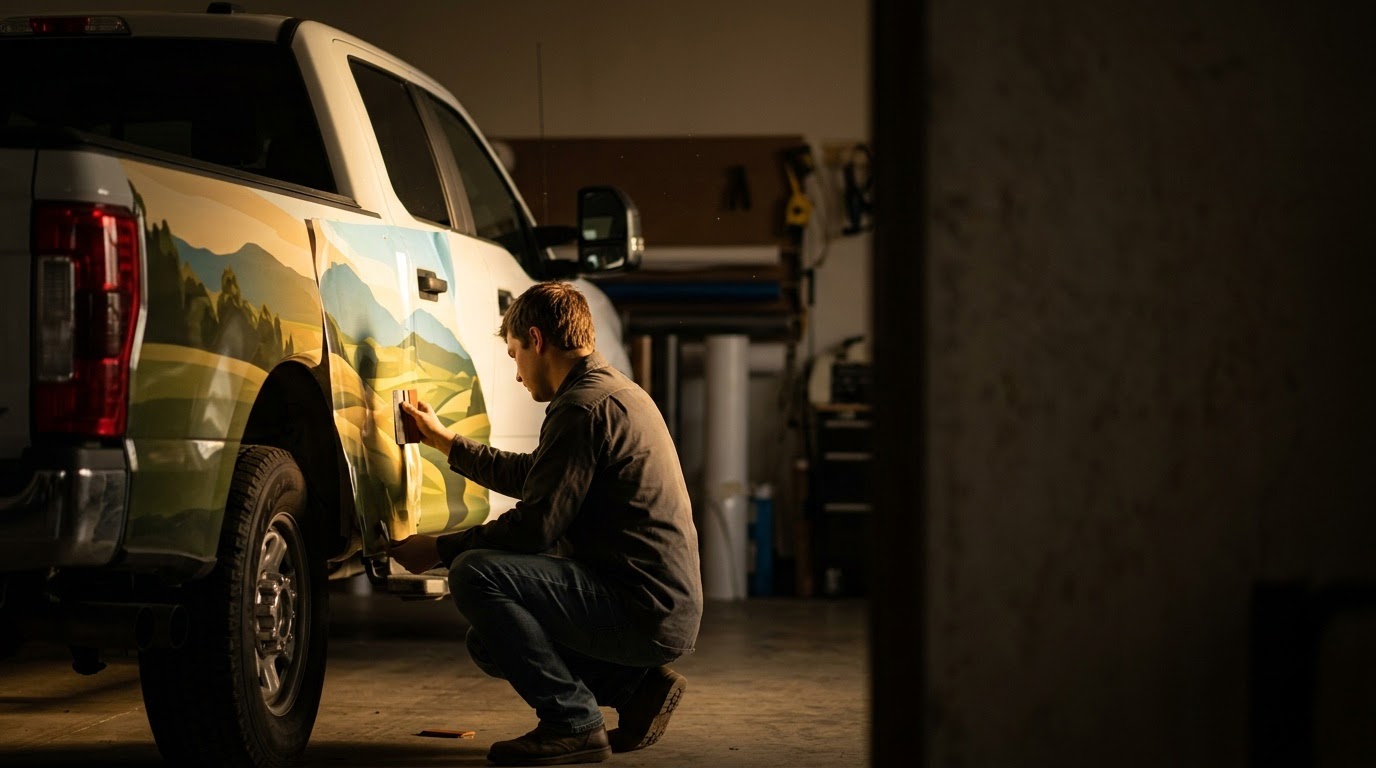
Your Truck Drives Past More People Than Your Facebook Page Reaches
Here's a thought experiment. Your service van is on the road six hours a day. It sits in a driveway on a residential street for two hours during a job. It's parked at the gas station, the lumber yard, the Mexican place on Main Street at noon.
Now count how many sets of eyes land on it in a single day in a town like London, Corbin, or Somerset. Then compare that to how many people actually saw — not scrolled past, saw — your last Facebook post.
For a lot of Kentucky service businesses, the truck wins. By a lot. And it costs you once instead of every month.
The problem is that most wraps, yard signs, and door hangers are designed like they're going to be read on a desk. They're not. They're read at 45 miles per hour, from a moving vehicle, by someone who's thinking about something else entirely. Physical marketing in small-town Kentucky still works — but only if the design obeys the physics of how people actually see it.
This is the playbook.
The One Rule That Governs All Of It: Three Seconds, Three Elements
Every piece of physical marketing you put out gets about three seconds of attention. Sometimes less. In that window, a person can process roughly three pieces of information. Not five. Not "and also our financing options."
Three.
For a service business, those three are almost always:
- What you do (plumbing, roofing, HVAC, excavation)
- Who you are (business name — and it should be big)
- How to reach you (phone number, in giant numerals)
That's it. Everything else — your website URL, your license number, your "family owned since 1998," your list of nine services, the logos of the five brands you carry — is secondary at best and visual noise at worst.
The single most common mistake we see on work trucks across southeastern Kentucky is a wrap that tries to be a brochure. Nine services listed in 2-inch text. A QR code. A website URL nobody will type. A photo of a smiling family. It all cancels out, and the truck communicates nothing except "this company has a wrap."
A plain white van with one giant phone number and the word PLUMBING outperforms a $4,000 full-color wrap that's too busy to read. That's not an exaggeration — it's just how reading at speed works.
Vehicle Wraps: Layout Standards That Actually Get Read
Size your text for distance, not for the design proof
When a designer shows you a wrap mockup on a laptop screen, everything looks legible. It's a 12-inch image on a desk. On the road, that van is 60 feet away and moving.
Use this as your working rule: one inch of letter height for every 10 feet of viewing distance. If you want your phone number readable from 100 feet, those numerals need to be about 10 inches tall. On the side of a cargo van, that means your phone number is going to feel uncomfortably huge on the proof.
Let it feel huge. That's correct.
Contrast beats color
Your brand colors matter less than the contrast between the text and whatever's behind it. Dark text on a light panel, or light text on a dark panel. Nothing in the middle.
Avoid:
- Text over a photograph (almost always unreadable at speed)
- Thin, elegant script fonts
- Gradients behind text
- Red text on a black background, or any two mid-tone colors fighting each other
Use heavy, wide sans-serif type. Think highway signage, not wedding invitation.
Design for the sides, not the back
The back of your truck gets read by the person stuck behind you at a light — a genuinely valuable audience, and the one place a short URL or QR code can actually work, since they have time.
But the sides are where the volume is. Every car you pass, every person at the gas pump, every neighbor who walks by while you're on a job. Design the sides as your primary billboard and treat the back as a bonus.
Put something on the tailgate and the hood
Two underused surfaces. The hood is visible in rearview mirrors — a business name across the hood gets read by the driver in front of you at every stoplight. The tailgate works the same way for the person behind.
Don't skip the service area
In rural Kentucky markets, people want to know you'll actually come to them. A line that says "Serving Laurel, Whitley & Knox Counties" answers a real objection before they ever call. Keep it small, keep it to one line, but include it.
If you operate across multiple towns, make sure your local market pages reinforce the same service area your truck claims. Consistency between what's on the road and what's online is part of why one drives calls to the other.
Yard Signs: The Most Underrated Tool You Own
A yard sign at a job site is a recommendation disguised as a sign. The neighbor doesn't just see your name — they see that someone on their street hired you. That's social proof you can't buy with ad spend.
The layout
An 18x24 yard sign has room for about five words and a phone number. That's the whole budget.
- Business name: top, largest element
- Service: one word or two
- Phone: bottom, nearly as large as the name
- Nothing else
Skip the website on yard signs. A person driving by a residential street is not going to type a URL. They might, however, remember a phone number — or, more likely, snap a photo of the sign at the stoplight.
The placement rules
- Angle it toward the road, not parallel to it. Signs installed flat against traffic flow get read by nobody.
- Set it at the property line, not against the house. Closer to the road, further from visual clutter.
- Ask before you plant it. Then actually ask — most homeowners say yes, especially if you offer something small for leaving it up two weeks.
- Go back and get it. A faded, leaning sign that's been in a yard for seven months says something about how you treat your work.
Use them in clusters
One sign on a street is a sign. Four signs in a neighborhood over three months is a reputation. If you land a job in a subdivision, that's not one job — that's a beachhead. Work that street.
Door Hangers: The Follow-Up Weapon Nobody Uses Right
Most door hangers are thrown away because they're generic. Here's the version that doesn't get thrown away:
You hang them on the 10–20 houses immediately surrounding a job you just completed. Not random neighborhoods. Not the whole zip code. The houses that can see your truck right now.
The copy changes everything:
"We just replaced a roof for your neighbor on [Street Name]. We're in the area this week — if you want a free look at yours, call [phone]."
That's not an ad. That's local information. It works because:
- It's specific to that street
- It's time-bound ("this week")
- It references a neighbor, which is the strongest form of proof in a small town
- It asks for something small (a look, not a sale)
Door hanger design standards
- One message. Not a service menu.
- Phone number large enough to read from arm's length while standing at the door
- No glossy finish — matte reads as local, glossy reads as junk mail
- Handwritten-style street name if you can swing it (even printed, it signals specificity)
The door hanger is also the one piece where a QR code genuinely earns its spot, because the person is standing still with a phone in their hand. Use it to go somewhere useful — a before/after gallery, a scheduling page — not your homepage.
How to Tell Which One Is Actually Working
This is where most service businesses give up and just assume it all helps. Don't.
Use a separate tracking number for each channel. A dedicated number on the trucks, a different one on yard signs, a third on door hangers. They all forward to the same phone. You answer the same way. But now your call log tells you exactly which piece of physical marketing is generating business.
If separate numbers feel like overkill, the cheap version is a single mandatory question at intake: "Mind if I ask how you found us?" Log the answer every single time, in the same place, with the same categories. A simple spreadsheet beats a gut feeling.
Then layer in the step most businesses miss: tie it to the job value, not just the call count. Yard signs might generate fewer calls than door hangers but produce higher-ticket jobs. Count the money, not the ring.
This is also exactly the kind of tracking that should be automatic rather than manual. Logging lead source, matching it to the closed job, and surfacing a monthly summary is a straightforward automation workflow — and once it runs on its own, you stop guessing about your marketing budget forever.
What To Do This Month
If you want a sequence rather than a list of ideas:
- Walk out to your truck and stand 60 feet away. If you can't read your phone number, your wrap is broken. That's your first fix.
- Order yard signs with five words and a phone number. Nothing else.
- Set a rule that every completed job gets a sign request — make it part of the closeout, not an afterthought.
- Print door hangers with blanks for the street name. Hang 15 after every job.
- Get three tracking numbers and start logging source on every call.
- Review the log at 60 days. Double down on what's producing. Kill what isn't.
Physical visibility and digital presence aren't competitors — they feed each other. Someone sees your truck, searches your name that night, and lands on your Google profile or your social accounts. If what they find there is dead or empty, the truck did its job and the website lost the lead.
That handoff is where most local service businesses leak revenue. Good photography of your actual crews and actual work closes the loop — it proves the truck they saw belongs to a real operation. That's worth getting done properly.
If you're running a service business in London, Corbin, Somerset, Richmond, or Lexington and you're not sure whether your trucks and signage are pulling their weight — or you want the offline and online sides finally working together instead of in separate universes — book a strategy call. We'll look at what you've got, tell you straight what's working and what's wasting money, and build you a plan you can actually execute.
 Cody NottinghamFounder & Director of Photography, Envision Media Co. · London, KY
Cody has run camera on 300+ shoots for 50+ businesses across southeastern Kentucky since 2022, from Somerset marinas to Corbin contractors to Lexington retail. He still shoots most jobs himself, which is where the specifics in these posts come from. More about Cody.