Your Website Photos Are Answering a Question You Never Asked
Someone lands on your site because they have a problem — a leaking water heater, a wedding in eight months, a tire that keeps going flat. Before they read a word of your copy, they've looked at your photos and decided something about you.
Most small business websites answer that unspoken question badly. Stock photos of models in spotless coveralls. A blurry phone shot of the storefront taken at noon. One headshot that looks like a driver's license photo.
None of that is a photography problem. It's a trust problem, and photography is what fixes it.
Here's the shot list we work from when we photograph a service business in London, Corbin, Somerset, or anywhere else across southeastern Kentucky — and the reasoning behind each shot, so you can brief a photographer properly or shoot some of it yourself.
Why Stock Photography Actively Hurts You
Stock photos fail for a specific reason: they're generically perfect. The mechanic has clean hands. The kitchen has no clutter. Everyone is smiling at nothing.
Customers read that instantly, even if they can't articulate it. What they take from it is that you had nothing real to show them.
Real photos of your actual work do three things stock can't:
- Capability — you clearly know how to do this
- Care — you take some pride in it
- Character — there are real people here
Stock can gesture at the first one. It can't touch the other two.
The Five Shots Every Service Business Needs
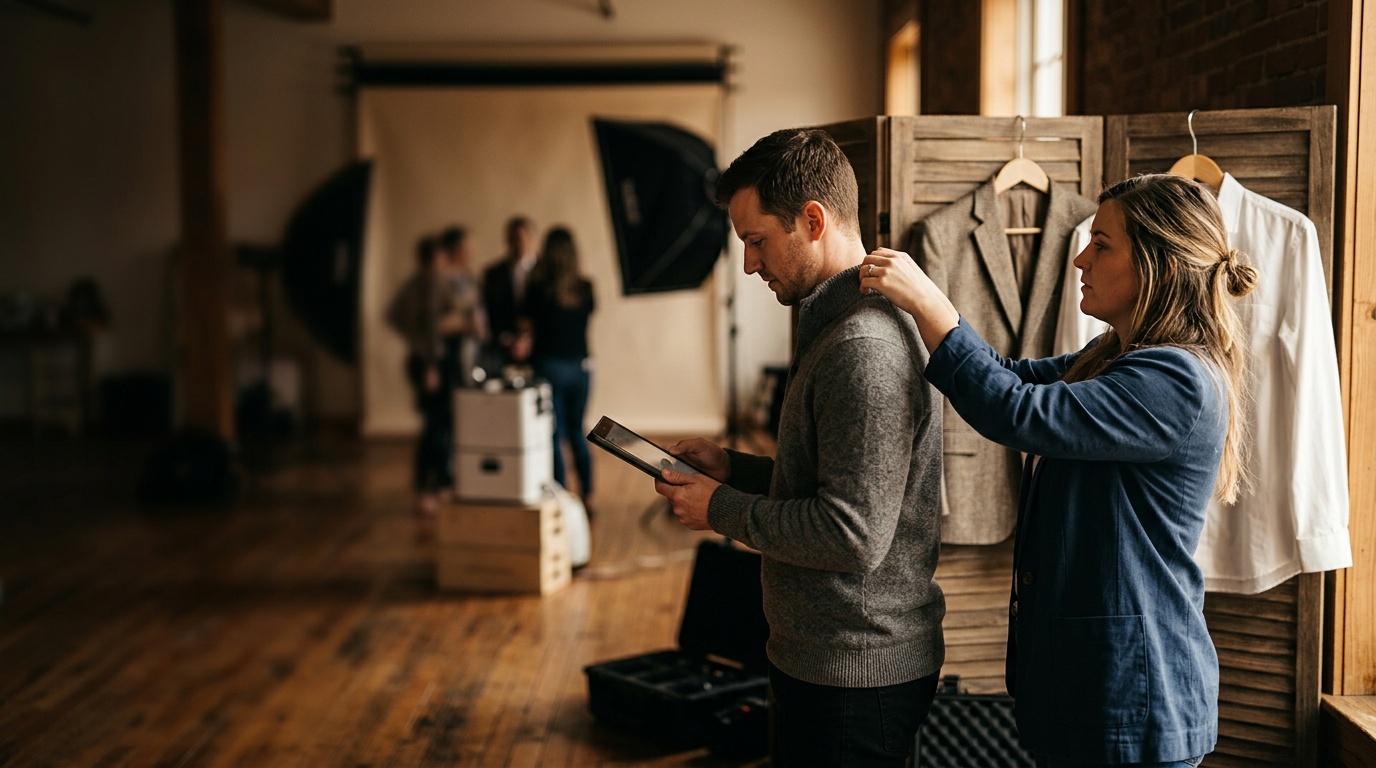
1. The Team in Action
Your people doing the actual work. Not posed, not looking at the camera, not holding a tool they don't use. Working.
Shoot it during a real job if you can. The details that make it believable — a hand steadying a piece, someone mid-sentence explaining something — only happen when work is actually happening.
Where it goes: above the fold on your homepage. It's the first thing a visitor sees and the fastest way to establish that there are competent humans behind the phone number.
2. The Process Reveal
A short series that walks through how the job actually gets done, start to finish. Inspection, the work itself, the quality check, the handover.
Most people have never watched a professional do what you do. They don't know what "done properly" looks like, which means they can't tell you apart from the cheapest quote they got. A process series teaches them the difference — and once they can see it, price stops being the only thing they're comparing.
Your competitors almost certainly aren't doing this.
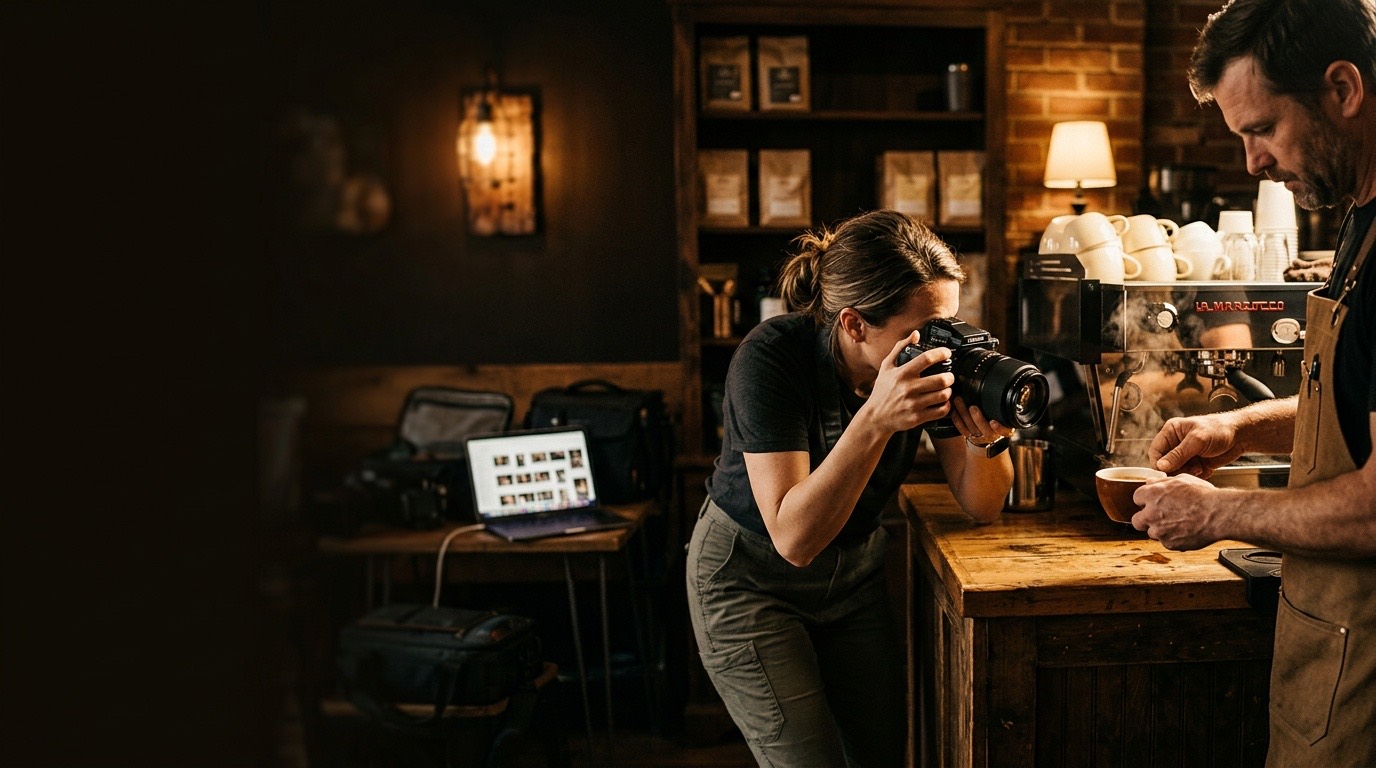
3. The Facility
Wide shots of the shop, the bay, the kitchen, the office. Organized, well-lit, clearly in use.
This one matters more than people expect for businesses on a main street or a back road. Plenty of customers drive past without stopping because they can't see inside and don't know what they'd be walking into. A few honest interior shots remove that hesitation before it happens.
Clean it up first — but don't stage it into a showroom. A workspace that looks unused reads as fake.
4. The Customer Interaction
You explaining something to a customer. Handing over keys. Walking someone through an estimate at the counter.
Get written permission from anyone recognizable, always. What this shot answers is the question nobody asks out loud: do people like me do business here? Photograph the customers you actually serve and the answer is obvious.
5. The Result, Close Up
Detail shots of finished work. A clean weld, a properly mounted tire, a finished install, a plated dish.
This is the shot that carries the most weight for the least effort, and it's the one most businesses skip because it feels too small to bother with. It isn't. It's the evidence.
Planning the Shoot
Before the Day
Clean and organize the space, but stop short of sterilizing it. Schedule the shoot during hours when real work is happening — an empty shop photographs like an empty shop.
Tell your team what's happening and why, in advance. People who've been told a photographer is coming behave far more naturally than people ambushed by one at 9am.
Then write the shot list. Walk through your customer's actual decision path and list the moments that would reassure them at each step. That list is your brief.
On the Day
Plan on four to six hours to get all five categories properly. Anything less and you'll get the hero shot and run out of daylight.
Use natural light as your base wherever you can — bay doors, windows, open shade — and fill the shadows rather than blasting them out. The goal is a room that looks like itself on a good day, not a studio.
Shoot far more than you think you need, especially of the process series. You'll want options once you see them at full size.
Afterwards
Replace the stock photos first, all of them, before you do anything clever. That single swap does more than any layout change.
Then put the strongest action shot above the fold, build a "how we work" section from the process series, and place the customer photos next to your written testimonials so the face and the words land together.
Ask your photographer for web-sized exports as well as full-resolution files. A 4MB hero image will undo whatever you gained — slow pages lose people before the photo ever renders.
What It Costs, Honestly
A proper commercial shoot for a small service business in Kentucky generally runs somewhere in the low thousands, depending on how many locations, how many hours, and how much retouching is involved. A half-day focused on one location costs meaningfully less than a full day across three.
We're not going to tell you it pays for itself in a month. What we can tell you plainly: photography is a fixed cost that sits underneath every other marketing thing you do. The same images run on your website, your Google Business Profile, your ads, your proposals, and your social accounts for the next two or three years. Bad photos quietly tax all of it. Good ones quietly subsidize all of it.
If you only have budget for part of it, buy the team-in-action shot and the process series. Those two carry the most weight.
The Short Version
- Real photos of real work beat stock, every time, for reasons customers feel rather than articulate
- Five categories cover it: team in action, process, facility, customer interaction, finished result
- Shoot during real working hours, in real light, with permission from anyone recognizable
- Swap out the stock photos before you change anything else on the page
- Export for web, or the speed hit will cancel out the gain
If you'd rather not run a shoot yourself, that's what we do. Envision Media Co. shoots photography and video for businesses across London, Corbin, Somerset, and the surrounding counties — and we'll tell you upfront which of these five shots your site actually needs. Book a free 15-minute call and we'll look at your current photos together.
Founder & Director of Photography, Envision Media Co. · London, KY
Cody has run camera on 300+ shoots for 50+ businesses across southeastern Kentucky since 2022, from Somerset marinas to Corbin contractors to Lexington retail. He still shoots most jobs himself, which is where the specifics in these posts come from. More about Cody.
Ready to Grow?
Let's Build Something Together
Want results like the ones we write about? Book a free strategy call and let's make it happen.